
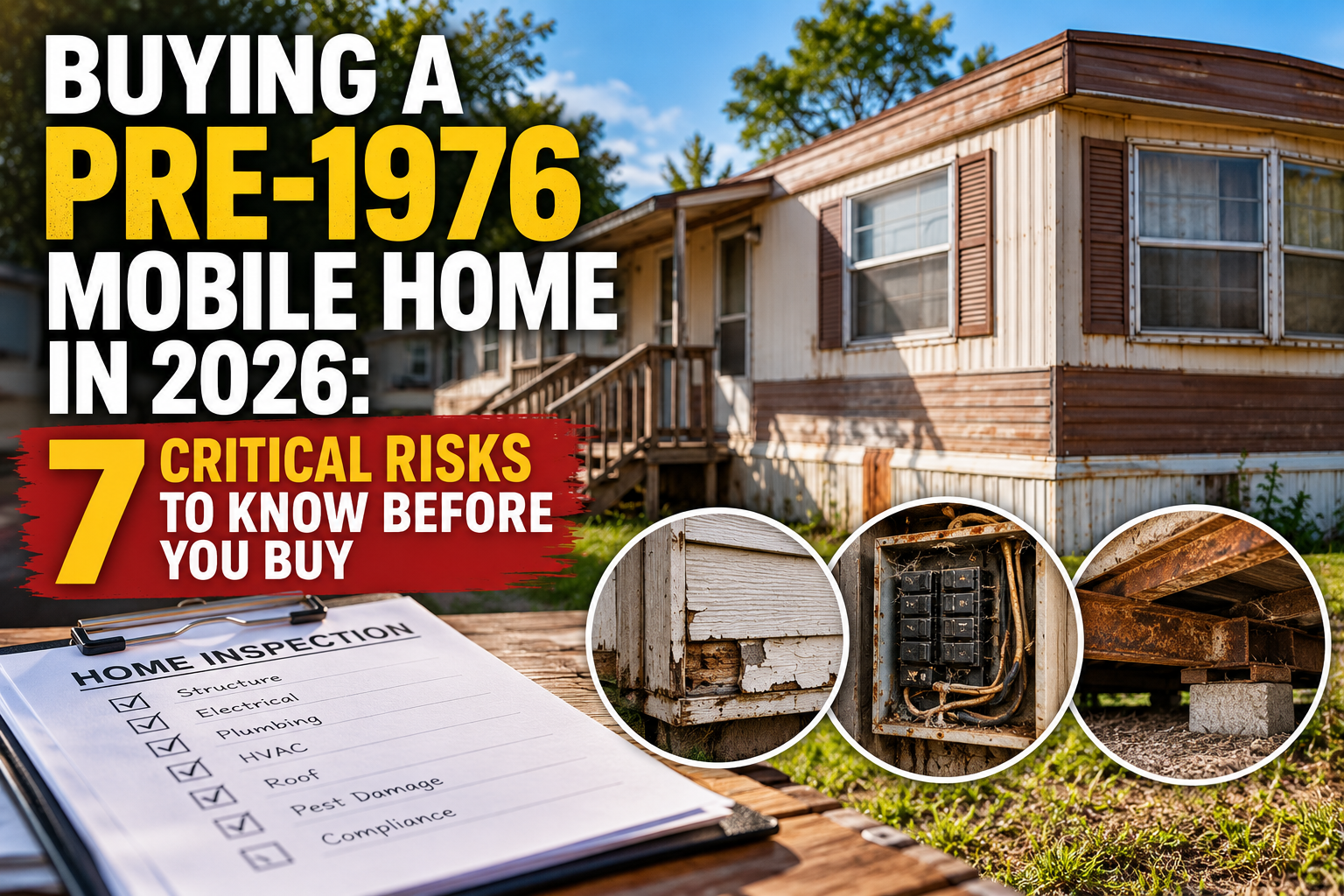
A pre-1976 mobile home can look like the bargain of the year. The price is often a fraction of a newer home’s, the lot rent may be reasonable, and some of these older homes have been lovingly kept for decades. For a buyer on a tight budget, that low asking price is hard to ignore.
But a home built before June 15, 1976, plays by different rules than every manufactured home built since. It may be harder to finance, harder to insure, and in some areas, impossible to move. None of that means you should walk away. It means you should know exactly what you’re buying.
This guide explains what makes a pre-1976 mobile home different, the seven biggest risks to check, when one can still be a smart buy, and how to inspect it before you hand over any money.
What Is a Pre-1976 Mobile Home?
On June 15, 1976, the federal Manufactured Home Construction and Safety Standards, commonly called the HUD Code, took effect. From that day on, every factory-built home had to meet national standards for construction, fire safety, plumbing, electrical systems, energy efficiency, and wind resistance.
That date is also where the names split. Homes built before it are technically mobile homes. Homes built after it, to HUD Code standards, are manufactured homes. People still use the two terms interchangeably, but lenders, insurers, and local governments don’t. For a deeper look at the differences, read our guide to mobile vs. manufactured vs. modular homes.
A home built under the HUD Code has two identifying markers:
- A HUD certification label, a small metal plate attached to the outside of each section.
- A data plate, a paper label inside the home listing the manufacturer, serial number, and build date.
A pre-1976 mobile home has neither. That missing label is the root of most of the challenges below.
How to Tell If a Home Was Built Before 1976
Don’t rely on the listing alone. Sellers sometimes guess at the year, or round it. Check these instead:
- Look for the HUD label. It’s a small metal plate on the outside of each section, usually near one end. No label is a strong sign the home is pre-HUD, though labels can also be removed or painted over.
- Find the data plate. Check kitchen cabinets, the bedroom closet, and near the electrical panel.
- Check the title. The model year on the title or ownership record is your best paper evidence.
- Ask the county. The assessor or tax office often records the year built.
If the home is newer but the label is missing, the owner can request a Letter of Label Verification through IBTS, which works with HUD on label records. A true pre-1976 mobile home can’t get one, because it was never labeled.
7 Critical Risks of Buying a Pre-1976 Mobile Home
1. Financing Is Very Limited
This is the biggest hurdle. Most mainstream loan programs only accept homes built to the HUD Code.
Fannie Mae’s guidelines require manufactured homes to comply with the federal construction standards that took effect June 15, 1976, and lenders must document the HUD data plate or certification labels. FHA loan programs have the same cutoff. Most chattel lenders that finance homes in parks also set a minimum year, often well after 1976.
In practice, most buyers of a pre-1976 mobile home pay cash, use seller financing, or take out a personal loan. Plan for that before you start shopping. Our guide to what credit score you need to buy a mobile home covers the financing options that do exist.
2. Insurance Can Be Hard to Find (and Pricier)
Many insurance companies limit coverage on older mobile homes, and some won’t write a policy at all on a pre-1976 mobile home. Others will, but only with an inspection, at a higher premium, or with actual-cash-value coverage instead of replacement cost.
Call two or three insurers before you make an offer, and get a real quote for the specific home. If you can’t insure it, many parks won’t let you live there, and you’ll carry all the risk yourself. Our guide to what insurance you need for a mobile home explains your coverage choices.
3. You May Not Be Able to Move It
This one surprises many buyers. Plenty of cities and counties won’t issue a placement permit for a home without a HUD label.
Show Low, Arizona, is a typical example. Its city code won’t permit installation of a manufactured home unless it carries a HUD decal and was built on or after June 15, 1976. Many other towns have similar rules.
Arizona also has a statewide process. According to the Arizona Department of Housing, a home built before June 15, 1976, must go through a state rehabilitation permit before it moves between Arizona parks or enters the state. Qualifying low-income owners may be reimbursed up to $1,500.
If you’re buying a pre-1976 mobile home, assume it needs to stay where it is unless you’ve confirmed otherwise. Moving any home is expensive anyway. See our breakdown of the cost to move a mobile home.
4. Parks May Not Accept It (or May Ask It to Leave)
Many communities set a minimum age for homes, especially when a home is sold. Some require older homes to be removed when ownership changes. Before you buy a pre-1976 mobile home in a park, get written confirmation from management that:
- You’ll be approved as a resident.
- The home can stay on its lot after the sale.
- No upgrades are required as a condition of approval.
If the park won’t put that in writing, treat it as a no.
5. Electrical and Fire Safety Concerns
Before the HUD Code, construction standards varied widely by manufacturer. Some homes from that era were built with aluminum branch wiring, undersized electrical service, fewer exits, smaller windows, and interior materials that burn faster than what’s used today.
These issues can be fixed. Many older homes have already been updated with new wiring, egress windows, and modern smoke alarms. But you need to know which ones you’re dealing with. Have a licensed electrician look at the panel and wiring, and make sure every bedroom has a working smoke alarm and a window you can get out of.
6. Wind and Weather Resistance
The HUD Code introduced wind zone standards that determine how strongly a home is built and anchored. A pre-1976 mobile home predates those standards, so it may be more vulnerable in high winds, especially if the tie-downs are old or missing.
If you live in a coastal or storm-prone area, check the anchoring system carefully and budget for upgrades. Our guide on whether mobile homes are safe in hurricanes and storms covers what to look for.
7. Lower Resale Value and a Smaller Buyer Pool
When you eventually sell, you’ll face the same limits you faced as a buyer. Most shoppers will need cash, some parks won’t approve the sale, and the home may not be movable. That shrinks your pool of buyers and usually your sale price.
That doesn’t make a pre-1976 mobile home a bad purchase. It just means you should buy it for the value of living in it, not as an investment. For more on how age affects value, see how long mobile homes last.
Pre-1976 Mobile Home vs. HUD Code Manufactured Home
| Pre-1976 Mobile Home | HUD Code Manufactured Home | |
|---|---|---|
| Built | Before June 15, 1976 | On or after June 15, 1976 |
| Federal construction standard | None | HUD Code |
| HUD label and data plate | No | Yes |
| Traditional or FHA financing | Rarely available | Often available |
| Insurance | Limited, often more expensive | Widely available |
| Can it be moved? | Restricted in many areas | Usually, with permits |
| Park acceptance | Often limited | Generally accepted |
| Purchase price | Usually very low | Higher |
When a Pre-1976 Mobile Home Can Still Be a Smart Buy
For the right buyer, an older home can make a lot of sense. A pre-1976 mobile home is worth a serious look if:
- You’re paying cash and the price is low enough that the risks are worth it.
- The home is staying put in a park or on land where it’s already approved.
- It’s been well maintained or updated, with newer wiring, roof, windows, plumbing, and tie-downs.
- You can insure it at a price that fits your budget.
- You plan to live in it long term rather than flip it.
Some buyers also purchase an older home mainly for the spot it sits on. If you own the land, or the lot is in a great community, the home may be a short-term place to live while you plan for a replacement. If that’s your plan, check our guide to putting a mobile home on your own land first.
Upgrades That Make an Older Home Safer and Easier to Insure
If you buy a pre-1976 mobile home, a few targeted upgrades can make it safer to live in, easier to insure, and more appealing to the next buyer. Prioritize these:
- Smoke and carbon monoxide alarms. Inexpensive and essential. Put one in every bedroom, in the hallway outside sleeping areas, and on every level.
- Electrical updates. Replacing an old or undersized panel, and addressing any aluminum branch wiring, is one of the most important safety upgrades. Always hire a licensed electrician.
- Egress windows. Make sure each bedroom has a window large enough to climb out of in an emergency.
- Tie-downs and anchoring. New anchors and straps improve wind resistance and can matter to insurers.
- Roof-over or roof coating. Many older homes have had a pitched roof-over added, which improves drainage and insulation.
- Plumbing and water heater. Replace aging supply lines and an old water heater before they fail.
- Skirting and underbelly repairs. These protect pipes and improve energy efficiency. Our guide to how to winterize a mobile home walks through them.
Keep receipts and permits for every upgrade. When it’s time to sell, a documented history of improvements is one of the best ways to show buyers a pre-1976 mobile home has been well cared for.
How to Make a Smart Offer on a Pre-1976 Mobile Home
Pricing older homes is tricky because there are fewer comparable sales and fewer buyers who can get financing. Use that to your advantage, fairly:
- Price it as a cash purchase. Because most buyers can’t finance a pre-1976 mobile home, the realistic buyer pool is smaller. That should be reflected in the price.
- Subtract the cost of needed repairs. Get rough quotes for anything the inspection turns up, such as electrical work, roof repairs, or new tie-downs, and factor them into your offer.
- Make the offer contingent. Write in contingencies for inspection, insurance approval, and written park approval, so you can walk away if any of them fall through.
- Ask about seller financing. Some sellers of older homes will carry the loan themselves. Get the terms in writing, and record any lien properly.
- Confirm the paperwork. Make sure the title is in the seller’s name and taxes are paid. Our guide on mobile home property taxes explains why unpaid taxes can block a sale.
For more negotiation strategies, see how to negotiate the best price on a mobile home.
Inspection Checklist for a Pre-1976 Mobile Home
Always get an inspection before buying an older home, ideally from an inspector who works with manufactured housing. Walk through these items yourself too:
- Electrical: Panel size and condition, any aluminum wiring, scorched outlets, or flickering lights.
- Roof: Leaks, soft spots, rust on metal roofs, and the age of any roof-over.
- Floors: Soft or spongy areas, especially near bathrooms, the kitchen, and doors.
- Plumbing: Pipe material, leaks under sinks, water heater age, and the condition of the underbelly.
- Windows and exits: At least two exterior doors and an escape window in each bedroom.
- Smoke and CO alarms: Present, working, and in every sleeping area.
- Heating: Furnace age, venting, and whether it’s approved for manufactured homes.
- Frame and tie-downs: Rust, damage, missing anchors, and whether the home is level.
- Paperwork: A clean title in the seller’s name, paid taxes, and written park approval.
Our guide on how to spot a great deal on a used mobile home has more tips for evaluating older listings.
Questions to Ask the Seller of a Pre-1976 Mobile Home
Before you make an offer, ask the seller these questions. Their answers will tell you a lot about how the home has been cared for and whether the sale will go smoothly.
- What year was the home built, and do you have the title in your name?
- Has the electrical system been updated? If so, when, and by whom?
- When was the roof last replaced or coated?
- Have the tie-downs or anchors ever been replaced?
- Are there any known leaks, soft floors, or past water damage?
- Has the park confirmed in writing that the home can stay after the sale?
- Who insures the home now, and what does the policy cost?
- Are property taxes paid through this year?
A seller who answers clearly, and can show receipts or paperwork, is a good sign. If a seller of a pre-1976 mobile home can’t answer the basics, slow down and verify everything yourself before moving forward.
Frequently Asked Questions
Can you get a loan for a pre-1976 mobile home? It’s difficult. Fannie Mae, FHA, and most chattel lenders require homes built to the HUD Code, which started June 15, 1976. Most buyers use cash, seller financing, or a personal loan.
Can you insure a pre-1976 mobile home? Often, but your choices may be limited. Some insurers decline older homes, while others require an inspection or charge higher premiums. Get quotes before you buy.
Can a pre-1976 mobile home be moved? Sometimes, but many cities and counties won’t permit placing a home without a HUD label, and some states require safety upgrades first. Check with the local building department before you plan a move.
How do I know if a mobile home was built before 1976? Look for the HUD label on the outside and the data plate inside. If neither exists, check the title and county records for the year built.
Can a pre-1976 mobile home be brought up to HUD Code? No. A home can’t be retroactively certified to the HUD Code, because the standard covers how it was built at the factory. You can make major safety upgrades, and some states, like Arizona, have their own rehabilitation programs, but the home will still be classified as a pre-HUD mobile home.
Is a pre-1976 mobile home worth buying? It can be, if the price is low, you’re paying cash, the home is staying where it is, and it’s in good condition. It’s usually not the right choice if you need financing or plan to resell soon.
Final Thoughts
A pre-1976 mobile home can be an affordable way into homeownership, but only if you go in with your eyes open. Confirm the year built, line up cash or seller financing, get insurance quotes and written park approval, and have the home inspected by someone who knows older manufactured housing.
Rules for older homes vary by state and city, so always check with your local building department and park management before you buy. This guide is general information, not legal or financial advice.
Ready to compare older homes with newer listings? Browse homes for sale on MoveInMobile.com and ask sellers about the year built, HUD label, and park approval before you make an offer.