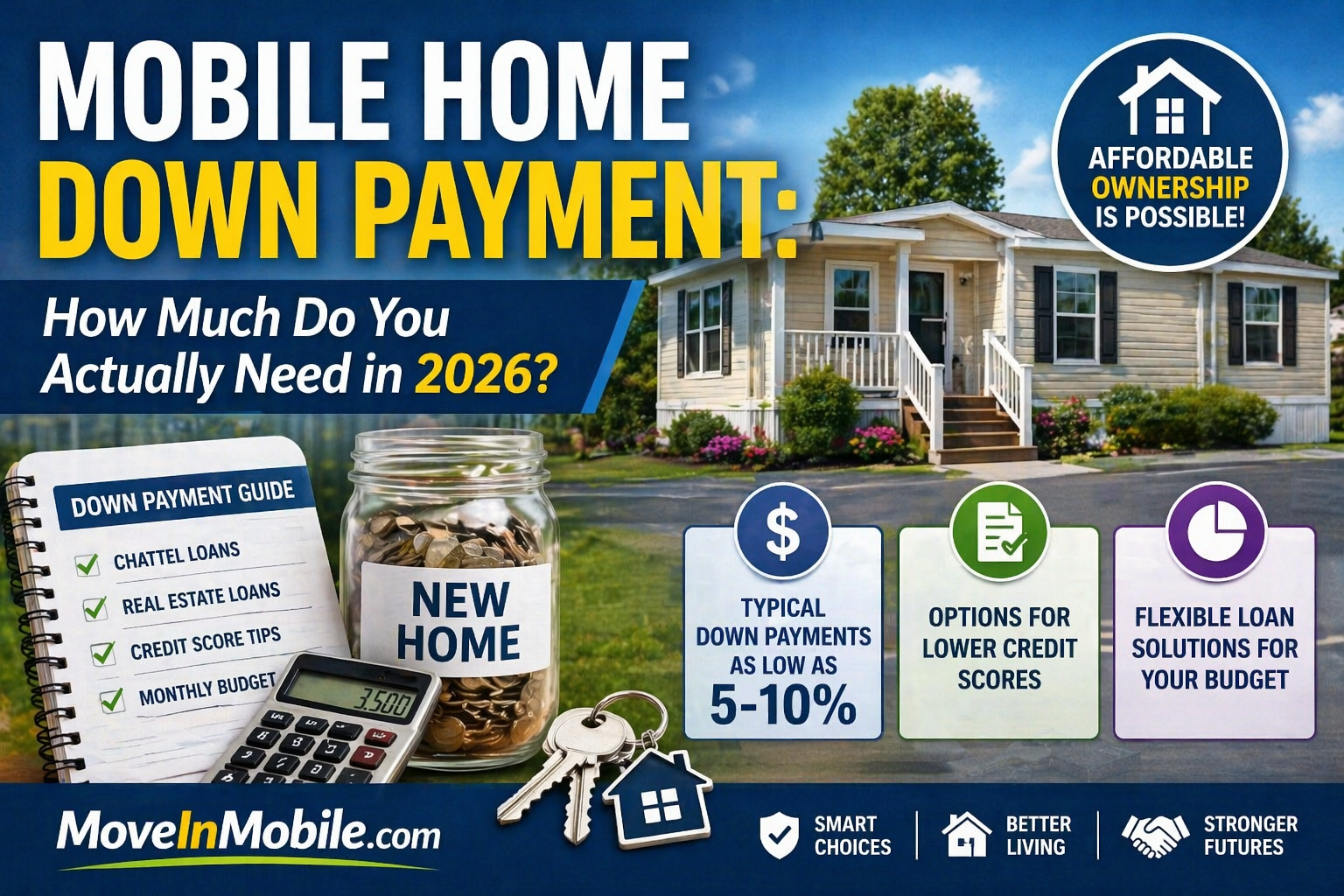
For most people considering a mobile home purchase in 2026, the down payment question comes up early — and the answers they find online are all over the place. Some sources say 5%. Others say 20%. Some say you can buy with nothing down at all.
The honest answer is that all of those can be true, depending on the loan type you qualify for and the kind of home you're buying. The good news is that manufactured housing tends to require significantly less upfront than a traditional site-built home — and there are real programs that allow buyers to get into a home with very little cash out of pocket.
Here's a clear, straightforward breakdown of what to expect in 2026.
Why the Down Payment Amount Varies So Much
The reason you see such different numbers is simple: there is no single loan program for mobile homes. Manufactured housing can be financed through FHA loans, VA loans, USDA loans, conventional loans, chattel loans, and seller financing — and each one has its own down payment requirement.
The type of home, the land situation, and your credit profile all factor into which programs are available to you. Here's how each one breaks down.
Down Payment Requirements by Loan Type
FHA Title I Loan (Home Only — No Land Required)
Minimum down payment: 5%
Best for: buyers placing a home in a mobile home park or on leased land
FHA Title I loans are specifically designed for manufactured homes that are not permanently attached to owned land. The minimum down payment is 5%, which on a $90,000 home means $4,500 upfront. These loans are federally backed, which means lenders take on less risk and can offer more accessible terms to buyers who might not qualify for conventional financing.
FHA Title II Loan (Home + Land, Classified as Real Property)
Minimum down payment: 3.5% (with a 580+ credit score)
Minimum down payment: 10% (with a 500–579 credit score)
Best for: buyers purchasing a manufactured home on land they own, permanently affixed and titled as real property
This is the closest equivalent to a traditional FHA mortgage and comes with the same low down payment structure. On a $150,000 home-and-land purchase, a 3.5% down payment works out to $5,250 — one of the most accessible entry points in homeownership available today.
VA Loan (Veterans and Active Military)
Minimum down payment: 0%
Best for: eligible veterans, active-duty service members, and surviving spouses
VA loans require no down payment for qualifying borrowers, and this benefit extends to manufactured housing that meets VA property standards. If you or your spouse has served, this is one of the most powerful financial tools available in the mobile home market — and it is significantly underused. The home typically needs to be on a permanent foundation and classified as real property to qualify.
USDA Loan (Rural Areas)
Minimum down payment: 0%
Best for: buyers in eligible rural and suburban areas who meet income limits
USDA loans also offer zero down payment financing, and many mobile home communities and private land parcels in rural Florida, Texas, the Carolinas, and the Southeast fall within USDA-eligible zones. The home must meet HUD code standards, the property must be the buyer's primary residence, and income limits apply based on the area median income for your county.
Conventional Loans (Fannie Mae MH Advantage / Freddie Mac CHOICEHome)
Minimum down payment: 3–5%
Best for: newer, qualifying manufactured homes that meet specific construction and site criteria
These programs have expanded meaningfully in recent years and allow buyers of eligible manufactured homes to access down payment requirements similar to traditional mortgages. The home typically needs to meet specific design and feature requirements — not every manufactured home qualifies — but for buyers whose home qualifies, 3% down is genuinely on the table.
Chattel Loan (Personal Property / Home Only)
Minimum down payment: typically 5–20%, with 10% being most common
Best for: homes in parks where you do not own the land
Chattel loans are the most common financing type in the mobile home market, especially for homes in communities. They move faster than real estate loans and have fewer property requirements, but they typically carry higher interest rates and require a slightly larger down payment than government-backed alternatives. Most chattel lenders look for 5–10% down, though some may require more depending on credit score and home age.
Seller Financing
Down payment: negotiable — often 10–20%, sometimes less
Best for: buyers with challenging credit or unique property situations
In the manufactured housing market, seller financing is more common than most buyers realize. A private seller or smaller dealer may be willing to carry the note directly, with a down payment negotiated between buyer and seller. This path has more flexibility than any institutional loan but also requires careful due diligence and a written agreement that protects both parties.
What If You Don't Have Much Saved?
One of the most consistent misconceptions about mobile home buying is that you need a large lump sum before you can get started. The math often tells a different story.
On a $80,000 used manufactured home financed with an FHA Title I loan at 5% down, the minimum down payment is $4,000. On a $110,000 home-and-land package financed with an FHA Title II loan at 3.5% down, you're looking at $3,850. For eligible veterans, the number is zero.
These are real, accessible numbers for buyers who have been told homeownership isn't within reach. Manufactured housing genuinely is one of the most practical paths to ownership for first-time buyers, buyers rebuilding financially, and buyers on fixed incomes.
Down payment assistance programs are also available in many states and counties. Florida, Texas, North Carolina, and several other states with large manufactured housing markets have HUD-approved housing counseling agencies and state-sponsored programs that help first-time buyers cover down payment and closing costs. These programs are not widely advertised, but they exist and they are legitimate.
What Else Goes Into Your Upfront Costs?
Down payment is the biggest line item, but it's not the only one. Before you budget for a purchase, make sure you're also accounting for:
Closing costs: On a real estate loan, closing costs typically run 2–5% of the loan amount. On a chattel loan, they tend to be lower — often 1–2% — but still real. Ask your lender for a Loan Estimate early in the process so there are no surprises.
Setup and installation: If the home is being delivered to land you own, site preparation, foundation work, utility hookups, and installation can add $5,000–$20,000 or more depending on the location and site conditions. This is separate from the home price and needs to be in your budget.
First month's lot rent: If you're moving into a community, many parks require first and last month's lot rent at move-in. Know this number before you commit.
Inspection fee: A professional inspection of a manufactured home typically costs $300–$600 and is money extremely well spent. Budget for it.
Moving costs: If the home needs to be transported from another location, factor in transport fees, permits, and setup.
None of these costs should scare you away from the purchase — but all of them should be in your planning before you make an offer.
How to Figure Out Which Loan Is Right for You
The best starting point is answering two questions: Do you own the land, or will you be renting a lot? And do you or your spouse qualify for VA or USDA benefits?
If you'll be renting a lot in a community, your most accessible options are FHA Title I and chattel financing. If you're buying land with the home, FHA Title II and conventional programs open up. If you're a veteran, start with VA — it's likely your best option regardless of the land situation.
From there, talking to a lender who actually specializes in manufactured housing is essential. Many traditional mortgage lenders don't handle chattel loans or Title I at all. Lenders who specialize in this market — including 21st Mortgage, Triad Financial Services, and Cascade Financial — understand the nuances and can give you an accurate picture of what you qualify for.
The Bottom Line
The down payment to buy a mobile home in 2026 can be as low as 0% for veterans and USDA-eligible buyers, 3–3.5% for FHA and certain conventional programs, 5–10% for chattel and Title I loans, and negotiable for seller financing. In most cases, the upfront cost to get into a manufactured home is significantly lower than buyers assume — and lower than almost any comparable site-built home on the market.
If you're ready to see what's out there, browse real mobile home listings right now at MoveInMobile.com. You can search by price, location, and home type — and every listing is from a real seller with no fluff, no ads, just homes worth looking at.
The path to ownership is more accessible than most people think. The first step is knowing your numbers — and now you do.